Churches are built around openness. People come through the doors for worship, meetings, classes, counseling, outreach programs, community meals, and special events. Many Pittsburgh churches also serve as gathering places throughout the week, not just on Sunday mornings.
That open and welcoming environment is part of what makes a church feel like home. At the same time, church leaders have a responsibility to think carefully about safety, access, and building security. The challenge is finding a balance between protection and hospitality.
Modern church security systems in Pittsburgh can help congregations protect people, property, and sensitive areas without making the building feel closed off or intimidating. With the right plan, security cameras, access control, and monitored alarms can work quietly in the background while church staff, volunteers, members, and visitors continue to feel welcome.
Church buildings are different from many other commercial facilities. A business may have one main entrance, set employee schedules, and limit public access. Churches often operate in a much more flexible way.
A typical church may have several entrances, multiple parking areas, classrooms, offices, fellowship halls, storage rooms, and worship spaces. Historic church buildings in Pittsburgh can be especially complex, with older layouts, side doors, basement entrances, and additions built over time. These features can make it harder to monitor who is entering the building and when.
Churches also welcome a wide range of people. Members, visitors, staff, volunteers, vendors, contractors, parents, children, and community partners may all use the facility during the week. Some churches host daycare programs, preschools, youth ministries, recovery meetings, food pantries, music rehearsals, and nonprofit events.
That level of activity is valuable, but it also creates practical security questions:
These questions do not need to be addressed with fear-based decisions. Instead, they can be approached through thoughtful planning. A well-designed security system helps churches stay open where they need to be open while adding structure where access should be limited.
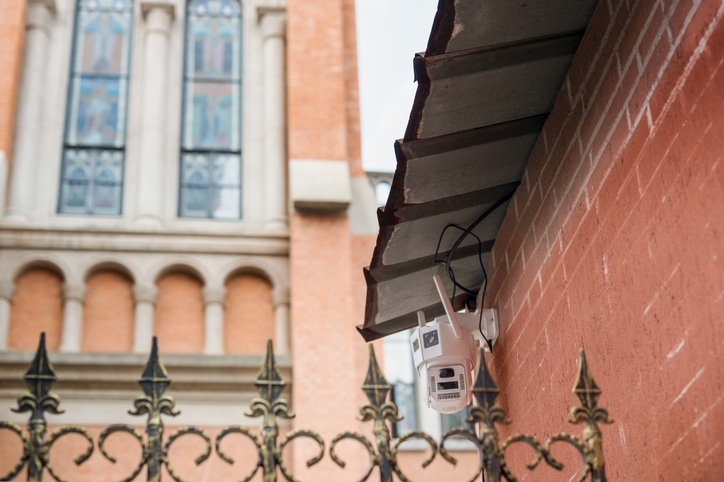
Church security cameras can be helpful when they are placed with care. The goal is not to make people feel watched during worship or fellowship. The goal is to raise awareness, protect key areas, and provide useful information in the event of an incident.
For many churches, camera placement starts with entry points. Cameras near main entrances, side doors, and parking lot access areas can help staff and leadership understand who is coming and going, which is especially useful for churches with multiple doors or older buildings where some entrances may not be visible from the main office.
Parking lot surveillance is another important consideration. Church parking areas may be used early in the morning, late in the evening, or during weekday programs. Cameras can help monitor activity around vehicles, walkways, and exterior doors.
Children’s ministry areas also require careful planning. Cameras may be used near check-in areas, hallways, and entrances to children’s spaces. Placement should support safety and accountability without interfering with privacy or creating discomfort for families. The details depend on the facility’s layout, the age groups served, and the church’s child safety policies.
Remote viewing can also be useful for church leaders and facility managers. With the right video surveillance system, authorized users can monitor the building from a secure device, which can be helpful during severe weather, after-hours events, maintenance visits, or when staff need to confirm whether a door area or parking lot looks normal.
The key is thoughtful design. Cameras should be placed where they serve a clear purpose. They do not need to be everywhere. A professional security provider can help you determine the locations most important to the church based on its schedule, building layout, and risk concerns.
Keys can become difficult to manage in a church environment. Staff members may need keys. Long-term volunteers may need keys. Maintenance workers, ministry leaders, musicians, teachers, and event coordinators may need occasional access. Over time, it can become hard to know who has a copy.
Church access control systems help solve this problem by replacing or reducing reliance on traditional keys. Instead of handing out physical keys, churches can use credential-based access, such as cards, fobs, or keypad codes. Access can be assigned based on role, schedule, or area of responsibility.
For example, a church administrator may need access to offices during the workweek. A children’s ministry volunteer may only need access to a classroom wing during scheduled program times. A maintenance provider may need temporary access to a mechanical room. Access control makes it easier to grant the right level of access without opening the entire building, which can be especially helpful for protecting restricted areas such as:
Access control also creates accountability. Church leaders can review access activity and make changes when roles shift. If a volunteer leaves, a credential can be removed from the system. There is no need to rekey multiple doors because one key was not returned.
For churches that host weddings, community programs, outside groups, or seasonal events, temporary access permissions can be useful. Rather than giving a visitor or event leader a permanent key, the church can provide access for a specific time period or location.
For more details on how access control works in commercial settings, SSA has also covered how access control systems help organizations manage access and accountability.
Churches are active places, but they are not occupied all the time. Many facilities sit empty overnight, during certain weekdays, on holidays, or between events, making church alarm monitoring especially important.
A commercial intrusion alarm can help detect unauthorized entry when no one is supposed to be inside the building. When paired with 24/7 professional monitoring, an alarm signal can be reviewed and addressed quickly in accordance with the church’s response plan.
This type of protection is useful beyond the sanctuary. Offices, classrooms, storage areas, fellowship halls, and equipment rooms may all contain items that matter to the church’s operations. For some churches, that may include sound equipment, computers, donation records, maintenance tools, musical instruments, or supplies for outreach programs.
Monitored alarm systems can also support church leadership by reducing uncertainty. If an alarm is triggered after hours, designated contacts can be notified. Depending on the system and monitoring plan, the appropriate response can be initiated without waiting for someone to discover the issue the next morning.
For churches with multiple buildings or campuses, monitoring can also help centralize awareness. Leadership does not have to rely solely on physical walkthroughs or on volunteers noticing a problem. A professionally monitored system adds another layer of support when facilities are unoccupied.
Effective Pittsburgh church security does not depend on a single device or a locked door. It usually works best as a layered plan.
Video surveillance helps church leaders see what is happening in important areas.
Access control helps manage who can enter certain spaces and when.
Professional monitoring helps protect the facility when no one is present.
Together, these tools can create a safer environment without changing the character of the church. The goal is not to make a church feel like a restricted building. The goal is to help staff and volunteers focus on ministry while knowing that practical safety measures are in place.
A layered plan may include cameras at exterior doors, access control on offices and children’s ministry areas, and monitored alarms for after-hours intrusion detection. For some churches, the first step may be a simple upgrade to alarm monitoring. For others, it may involve integrating several systems across a larger campus.
The right plan depends on the facility. A historic church in the city may have different needs than a newer suburban campus. A church with a daycare program may have different priorities than a church that primarily hosts Sunday services and midweek meetings.
A congregation that shares its building with nonprofit partners may need a more detailed access schedule, which is why a facility-specific assessment matters. Church leaders should not have to guess which doors, rooms, or parking areas need attention. A local security partner can walk the property, ask practical questions, and recommend a plan that fits the building’s use.
SSA also offers guidance on creating safer environments through security planning, which can be helpful for churches thinking through safety in a broader organizational context.
Many Pittsburgh churches serve as more than worship spaces. They are community centers, education spaces, support hubs, and gathering places. Some operate out of historic buildings with older infrastructure. Others manage large campuses with schools, daycare programs, offices, gyms, or fellowship halls.
Security planning should respect that mission. A church should still feel open, calm, and welcoming. At the same time, leaders can take reasonable steps to protect children’s areas, manage access, monitor activity, and respond to after-hours concerns.
Security Systems of America works with churches and other organizations to design integrated security solutions that fit real facilities and real schedules. SSA’s services include video surveillance systems, access control systems, commercial intrusion alarms, 24/7 professional monitoring, and integrated security planning.
If your church is reviewing its current security plan, SSA, a specialist in security systems for houses of worship, can help you evaluate your building, entrances, restricted areas, parking lots, and after-hours needs.
Request a Church Security Assessment to receive local, facility-specific recommendations from a Pittsburgh security team. There is no obligation, and the goal is to help your leadership team understand practical options that support both safety and hospitality.
You can also speak with a Pittsburgh church security specialist to discuss cameras, access control, alarm monitoring, or an integrated plan for your church facility.